

How to Manage School Assignments Alongside Competitive Exam Preparation


Preparing for school examinations while studying for competitive entrance tests can be challenging, especially when both demand consistent effort. Students preparing for examinations such as JEE and NEET must understand school concepts, complete assignments, revise lessons, and practise questions under time constraints. Without a clear plan, even motivated students can feel overwhelmed by their academic workload.
The challenge is not simply finding more hours to study. It is deciding what deserves attention, using available time effectively, and maintaining steady progress across different academic responsibilities.

Understanding the Challenges of Managing Both
School education and competitive exam preparation are connected, but they do not always follow the same pace or format. Schoolwork often includes written assignments, practical records, internal assessments, and preparation for periodic tests. Competitive exams demand conceptual clarity, application-based learning, extensive practice, and the ability to solve questions within strict time limits.
01Limited Time
School hours, commuting, coaching, and homework all compete for the same hours.
02Different Requirements
School favours written explanations; entrance exams test speed and application.
03Inconsistent Revision
A topic understood in class can be forgotten without a revisit.
04Mental Fatigue
Long sessions without breaks reduce concentration and make learning harder.
05Competing Deadlines
A school project can interrupt an established entrance-exam schedule.
Recognising these challenges helps students build a routine around their actual commitments rather than following an unrealistic timetable.
Create a Practical Study Plan
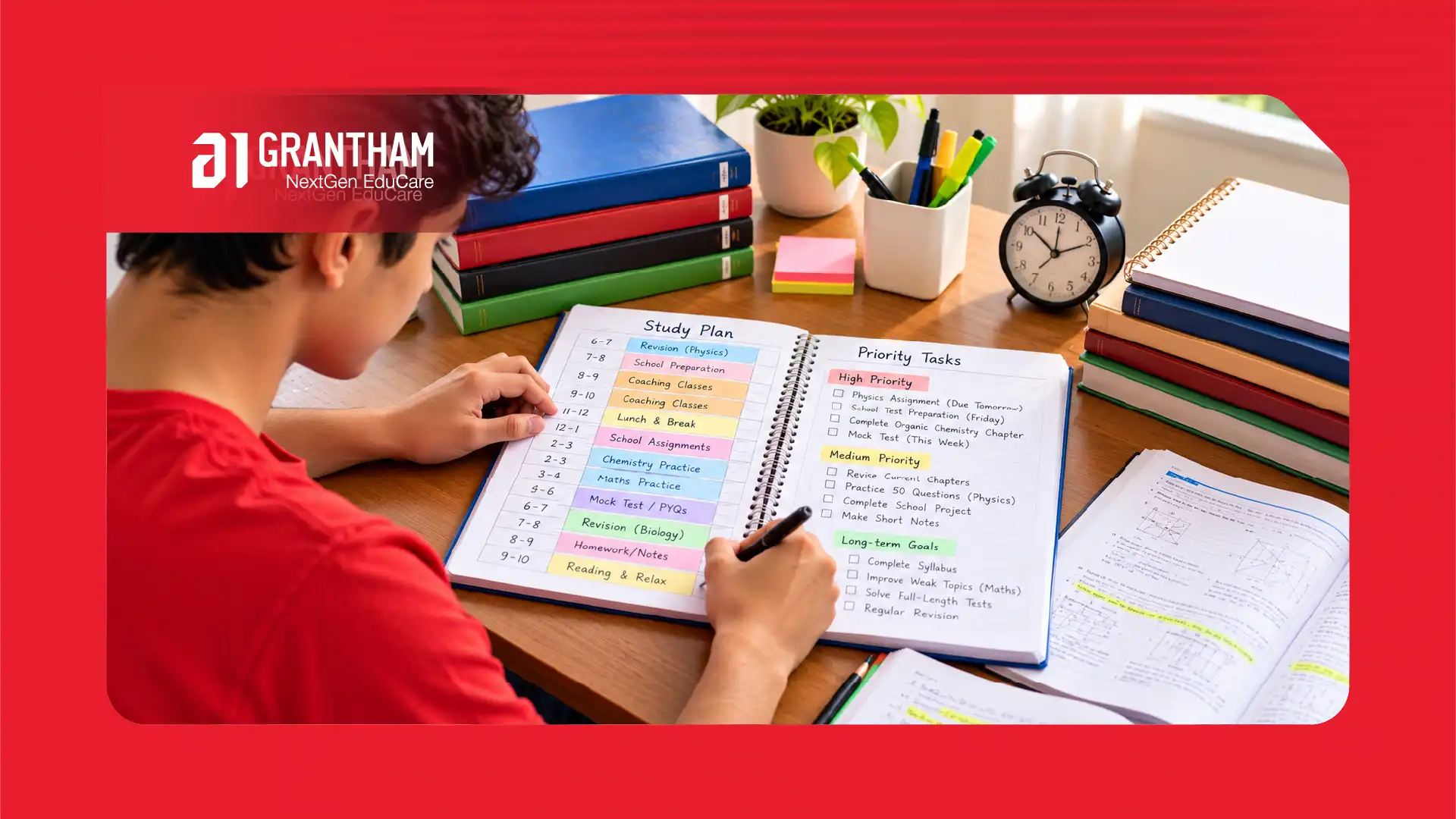
A well-designed study plan provides direction without making every hour feel like a deadline. Before creating one, students should list their regular commitments, including school, coaching, homework, revision, meals, travel, and sleep. The next step is to identify the time available for independent study — a timetable should reflect a student’s real energy levels and responsibilities, not an idealised version of a productive day.
| Priority | Examples |
|---|---|
| High Priority | An assignment due tomorrow, a test later this week, a difficult topic needed for an upcoming mock test |
| Medium Priority | Revising recently completed chapters, a planned set of practice questions |
| Long-Term Priority | Completing the syllabus, strengthening weak subjects, full-length mock exams |
This approach prevents students from spending excessive time on minor tasks while postponing essential preparation. Daily planning helps manage immediate responsibilities, while weekly planning ensures long-term progress — review upcoming school deadlines, coaching tests, and revision targets at the start of each week, and keep some unallocated time for unexpected assignments or difficult topics. A plan with no flexibility can become difficult to follow after a single disruption. Research on time management supports this structured approach: stronger time-management skills are consistently associated with better academic performance among students juggling demanding, overlapping coursework.
Improve School Assignment Management
School assignments are a necessary part of academic life, but they can consume more time than expected when students postpone them or approach them without a clear method. Effective school assignment management begins with understanding the task before starting it — read the instructions carefully, identify the required format, and estimate how long the work should take.
01Break It Into Stages
Research, outlining, drafting, diagrams, editing, submission — tackled one at a time.
02Match Energy to Difficulty
Do the demanding stages when concentration is strongest; save formatting for low-energy slots.
03Avoid Over-Polishing
Meet the requirements clearly rather than chasing unnecessary perfection.
04Use Small Time Blocks
A 20-minute gap can finish a written response or organise references.
Reserve longer, uninterrupted sessions for demanding activities such as solving difficult physics problems or understanding unfamiliar concepts.
Identify Topics That Overlap
One of the most efficient ways to manage school and competitive exam preparation is to recognise where the two syllabuses overlap. For students preparing for JEE and NEET, school lessons often introduce concepts that are also important for entrance examinations. Studying these topics with both purposes in mind can reduce unnecessary duplication.
01Understand in Class
Grasp the concept as it’s taught, the first time.
02Complete the Schoolwork
Finish the related assignment while the concept is fresh.
03Review Definitions & Exceptions
Go a level deeper than the school treatment requires.
04Solve Entrance-Level Questions
Apply the same concept at competitive-exam difficulty.
05Record & Revisit Mistakes
Close the loop instead of moving straight to the next topic.
However, syllabus overlap should not be assumed to be complete. Competitive exams may test concepts in greater depth or require applications that are not emphasised in school lessons — students should check the relevant examination syllabus and adjust their preparation accordingly, the same way a connected academic foundation for students is built concept by concept rather than subject by subject.
Maintain a Balanced JEE Study Routine
JEE preparation requires a strong understanding of physics, chemistry, and mathematics, along with regular numerical practice. Students must learn to apply concepts to unfamiliar problems rather than relying entirely on memorisation. Maintaining a JEE study balance becomes easier when school learning and entrance exam practice are coordinated.
When a topic is introduced in school or coaching, focus first on understanding the underlying principles — memorising formulas without understanding their application can make complex questions difficult to solve. After learning a concept, practise questions in increasing levels of difficulty, starting straightforward and progressing to questions that combine multiple concepts.
Short, consistent problem-solving sessions are often more manageable than occasional marathon sessions. After each session, review incorrect answers and determine whether the mistake resulted from a conceptual gap, calculation error, misreading, or poor time management. Learning a chapter once is not enough for long-term retention — revisit formulas, concepts, and previously solved questions at planned intervals, reviewing the topic the next day, revisiting it after several days, and testing understanding again after a few weeks.
Build a Consistent NEET Preparation Schedule
NEET preparation involves physics, chemistry, and biology. Biology requires detailed understanding and recall, while physics often demands numerical practice, and chemistry includes conceptual, numerical, and memory-based components. A realistic NEET preparation schedule should account for these differences instead of allocating identical study methods to every subject.
Biology & Chemistry
- Read the prescribed textbook carefully and revise diagrams and terminology
- Review reactions and conditions, practise numericals where needed
- Practise relevant multiple-choice questions regularly
Physics
- Understand formulas before attempting numerical problems
- Work through solved examples closely
- Solve numerical questions independently afterwards
Active recall involves retrieving information from memory rather than simply rereading it. After studying a biology topic, close the book and try to explain the main processes, definitions, or diagrams from memory — for chemistry, recall reactions and conditions before checking the notes; for physics, write down relevant formulas and explain when they apply. This reveals what has actually been understood and what requires further revision. Multiple-choice practice should always be followed by analysis: maintain a record of recurring errors, unfamiliar concepts, and questions that take too long to solve.
Manage Academic Workload Without Exhaustion
A timetable may appear productive on paper but fail in practice if it leaves no room for rest. Sleep deprivation, constant pressure, and excessive study hours can affect concentration, memory, and decision-making. Managing academic workload therefore requires attention to both productivity and recovery.
01Set Realistic Targets
“Solve 25 questions, then error-analyse” beats “study chemistry for three hours.”
02Take Planned Breaks
40–50 minutes of focus followed by a short, genuine break.
03Protect Sleep
Teenagers generally need around eight to ten hours a night.
04Keep the Basics Steady
Regular meals, hydration, and physical activity all support study performance.
Sacrificing sleep repeatedly to finish routine work can make the following day less productive, creating a cycle of fatigue and unfinished tasks. This is consistent with research on student sleep patterns, which has found that better sleep quality, duration, and consistency are associated with stronger academic performance, independent of how many hours a student reports studying — a reminder that protecting rest is part of the preparation, not a trade-off against it.
Use Study Planning to Track Progress
A study plan is useful only when students review whether it is working. Tracking progress helps them make informed changes instead of repeatedly creating new timetables. At the end of each week, review which school assignments were completed on time, which topics were revised as planned, what mistakes appeared repeatedly in practice questions, and whether the study targets were realistic alongside school and coaching.
A simple tracker can include the topic, planned task, completion status, and next revision date — students do not need complicated productivity systems; a notebook, calendar, or basic spreadsheet can be sufficient. Mock tests should also be used strategically: analyse performance after each test, identify the causes of incorrect answers, and revise weak areas before taking another test. Scores provide useful feedback, but the analysis of those scores is what guides improvement.
Make Technology Support Your Routine
Digital tools can simplify planning when used with clear limits. Calendar applications, reminders, digital flashcards, and question-practice platforms can help students organise deadlines and revision. However, frequent notifications and uncontrolled screen time can interrupt concentration.
01Phone Away While Studying
Keep it out of reach during focused sessions.
02Digital Flashcards
Useful for short, targeted revision sessions.
03Reminders for Deadlines
Assignments and upcoming tests flagged automatically.
04Download Materials Ahead
Reduce mid-session distractions by preparing in advance.
Technology should reduce the effort required to organise studying, not become another source of distraction.
Conclusion
Managing school assignments alongside competitive exam preparation requires more than a demanding timetable. It depends on prioritising tasks, recognising syllabus overlap, practising consistently, and reviewing progress regularly.
Effective school assignment management helps students meet academic deadlines without allowing routine work to consume every available hour. A balanced JEE study balance or NEET preparation schedule also needs to reflect subject requirements, personal learning needs, and realistic time constraints.
Students who approach their academic workload strategically can build stronger concepts, maintain regular revision, and prepare more confidently for examinations. The aim is not to study every available minute but to make each study session purposeful. With consistent planning, adequate rest, and a willingness to adjust the routine, students can manage both responsibilities more effectively.
Want Help Building a Realistic Study Routine?
Talk to Grantham NextGen Educare’s mentors about balancing school assignments with focused JEE or NEET preparation.
Book a Free Consultation →FAQs
1. How can students balance school and competitive exam preparation?
Students should plan their week around school hours, assignments, coaching, revision, and practice tests. Prioritising deadlines, combining overlapping topics, and setting realistic daily targets can help them manage both responsibilities.
2. How many hours should students study after school?
There is no fixed number that works for everyone. The appropriate duration depends on school hours, coaching commitments, examination timelines, and individual needs. Focused study with clear objectives is generally more useful than following an exhausting schedule that cannot be maintained.
3. How can students complete school assignments faster?
Students can begin by understanding the instructions, dividing larger tasks into smaller stages, and setting deadlines for each stage. Starting early and avoiding unnecessary perfectionism can prevent assignments from interfering with competitive exam preparation.
4. How should students prepare for JEE or NEET while attending school?
Students should strengthen concepts taught in class, practise entrance-exam-level questions on relevant topics, and revise regularly. JEE candidates should prioritise conceptual problem-solving, while NEET candidates should combine detailed subject revision with consistent multiple-choice practice.
5. What should students do if they fall behind their study schedule?
They should review unfinished tasks, identify the most urgent priorities, and revise the upcoming plan. Trying to complete every missed task in one day can lead to exhaustion. A more effective approach is to address important gaps first and return to a manageable routine.
