

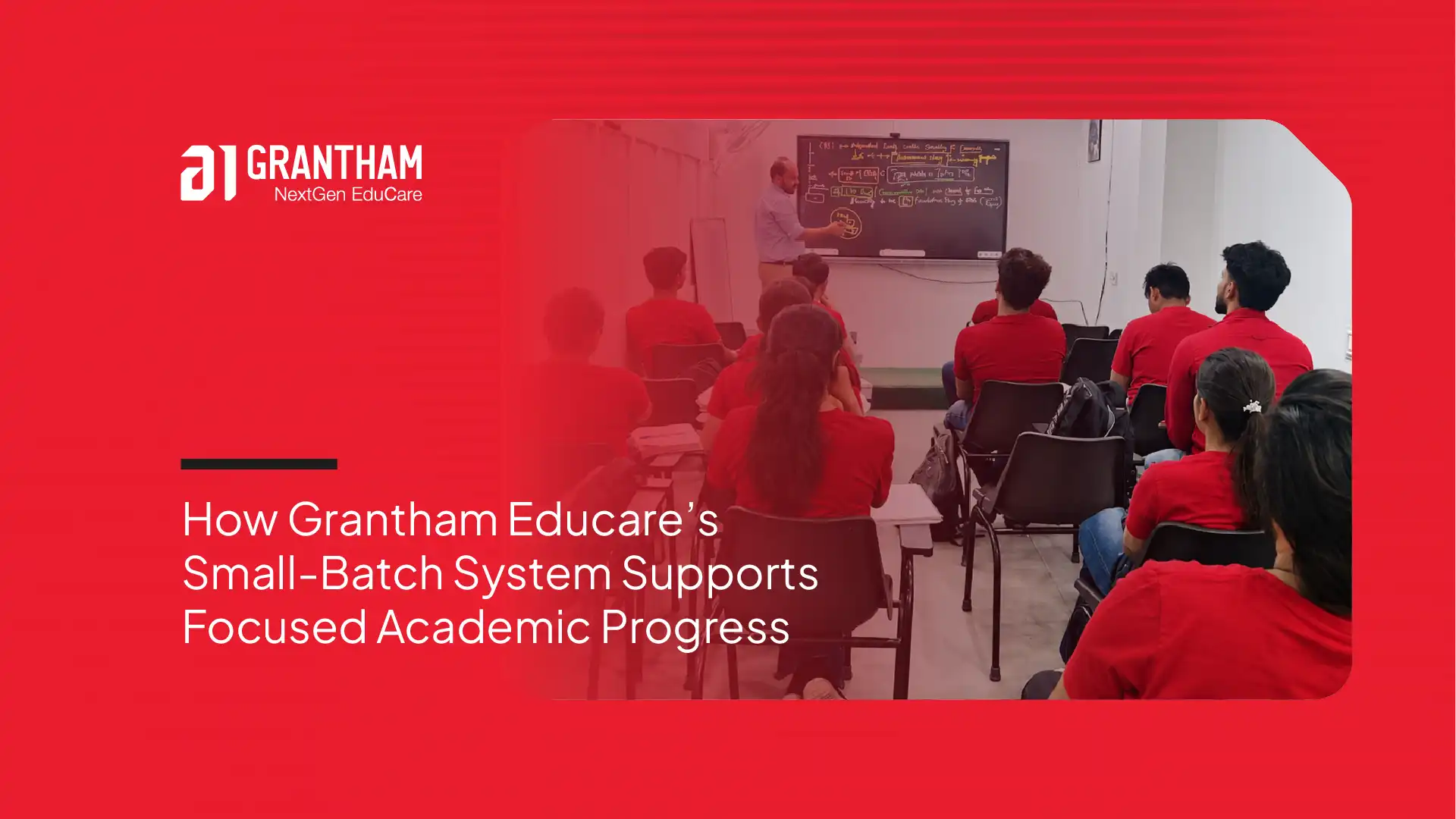
How Grantham Educare’s Small-Batch System Supports Focused Academic Progress

Academic success is rarely the result of studying for long hours alone. It depends on how well students understand concepts, how consistently they practise, and how effectively they address their weaknesses. For students preparing for board examinations and competitive entrance tests, these demands can become particularly challenging.
The learning environment plays an important role in this process. In a crowded classroom, students may hesitate to ask questions or struggle to receive individual feedback. Teachers, meanwhile, may find it difficult to identify every student’s learning gaps while maintaining the pace of the syllabus.
This is one reason small batch coaching in Pune can be a valuable option for students seeking a more focused academic experience. Smaller groups can create greater opportunities for interaction, targeted guidance, and regular evaluation.

Why Small Batches Matter in Science Education
Science subjects require more than memorising facts and formulas. Students must understand relationships between concepts, interpret questions accurately, and apply their knowledge to different situations. Physics requires logical reasoning and mathematical problem-solving. Chemistry combines conceptual understanding, calculations, and the interpretation of reactions. Biology demands detailed knowledge, accurate recall, and an understanding of how different processes connect.
Students may struggle with these subjects for different reasons. One might understand a formula but fail to recognise when to use it. Another may memorise a biological process without understanding its underlying mechanism. Treating both difficulties in the same way may not produce the desired improvement.
A smaller classroom can give teachers more opportunities to identify such differences and respond with appropriate explanations or practice exercises. This is supported by research on class size in science and other subjects, which has found that smaller class sizes in primary and secondary schools are associated with improved student achievement, particularly when teachers use the additional capacity for more individualised instruction. The objective is not to suggest that larger classrooms cannot produce excellent results — rather, smaller groups can make certain forms of individual attention easier to provide, particularly when lessons involve challenging concepts and detailed problem-solving.
More Opportunities for Individual Attention
Students rarely progress at exactly the same pace. Some grasp new concepts quickly, while others need additional explanation or time to practise before moving forward. In a small-batch setting, teachers may find it easier to recognise these differences and identify where support is needed.
For example, a student struggling with numerical problems in Physics may not need to repeat the entire chapter. The actual difficulty could lie in rearranging equations, understanding units, or applying a particular principle. Identifying the precise issue allows practice to become more targeted.
01Clarify Early
Difficult concepts addressed before misunderstandings become persistent.
02Feedback on Approach
Not just the final answer, but how a student got there.
03Spot Recurring Errors
Patterns in calculation or reasoning caught early.
04Doubts Asked in Real Time
Resolved during the lesson, not postponed indefinitely.
05Confidence Through Guided Practice
Built step by step, not assumed.
This approach can be particularly useful when new concepts depend on previously learned material. Addressing foundational gaps early makes subsequent learning more manageable.
Encouraging Active Classroom Participation
Listening to an explanation is only one part of learning. Students also need opportunities to apply what they have understood. In smaller groups, teachers can encourage learners to solve questions independently, explain their methods, compare alternative approaches, and discuss why particular answers are correct.
These activities reveal whether students genuinely understand a concept or are simply following a demonstrated solution. Consider a student who can reproduce a mathematical formula but cannot explain why it applies to a specific problem — asking the student to describe the reasoning behind the solution can reveal the gap and help the teacher address it.
Regular participation also encourages students to take greater responsibility for their learning. Instead of treating doubts as something to resolve immediately before examinations, they begin recognising questions as a normal part of academic development — the same mindset that supports a steady academic foundation for students more broadly.

Timely Feedback and Correction
Feedback becomes more useful when it explains the reason behind an incorrect answer. A mistake may result from weak conceptual understanding, inaccurate calculations, misreading a question, or poor time management. Each problem requires a different response.
For example, a student who understands a concept but repeatedly makes calculation errors may benefit from a different practice strategy than someone who has misunderstood the underlying principle. A focused teaching environment can provide opportunities to examine these patterns and recommend suitable corrective work.
This matters particularly in competitive examinations, where students must combine accuracy with speed. Repeating an incorrect method can reinforce the problem, while timely correction helps develop more reliable techniques — a pattern supported by research on feedback timing, which has found that timely, well-targeted formative feedback is associated with stronger student motivation and more effective learning outcomes than feedback that arrives long after the work was done.
Supporting Board Exam Coaching Through Conceptual Clarity
Board examinations require students to demonstrate knowledge in a prescribed format. Depending on the subject and question, they may need to explain concepts, present calculations accurately, draw labelled diagrams, or structure written answers clearly. Effective board exam coaching should therefore extend beyond completing chapters — students need opportunities to practise the way knowledge will be assessed.
01Revise Definitions
Textbook concepts kept sharp, not just covered once.
02Practise Presentation
Numerical questions and written explanations in the expected format.
03Solve Previous Papers
Familiarity with marking schemes and answer structure.
04Chapter-Wise Tests
Weak areas identified while there’s still time to fix them.
Small batches can support this process by creating more opportunities for teachers to review individual responses and explain where answers need improvement. Students preparing for competitive examinations at the same time should also understand how board requirements differ from entrance-test expectations — the aim is to develop a strong academic foundation that serves students across different assessment formats.
JEE NEET Coaching: Building the Ability to Apply Concepts
JEE and NEET preparation demands sustained practice, conceptual depth, and familiarity with different question types. For JEE aspirants, Physics, Chemistry, and Mathematics require logical reasoning, numerical practice, and the ability to connect related concepts. NEET aspirants must develop similar problem-solving skills in Physics and Chemistry while building detailed knowledge of Biology.
Quality JEE NEET coaching should balance explanation with independent problem-solving. Students need to understand why a method works, not merely memorise the steps required to reach an answer. A smaller learning group can make it easier to discuss challenging questions and identify individual difficulties — a student struggling with mechanics may need to strengthen foundational concepts before attempting advanced problems, while a Biology student who confuses related processes may benefit from comparing their functions and differences systematically.
However, coaching cannot replace independent effort. Students still need to revise regularly, complete assignments, practise questions without assistance, and analyse mock-test performance. The learning environment provides direction, but progress depends on how consistently students apply it.
Making MHT-CET Preparation More Effective
MHT-CET preparation requires familiarity with the syllabus, regular question practice, and the ability to manage time during the examination. A common difficulty arises when students can follow a solution during a lecture but struggle to solve a similar question independently — understanding an explanation and applying a concept without assistance are different skills. Regular practice helps bridge this gap.
An organised MHT-CET preparation plan should include chapter-wise questions, timed exercises, periodic revision, and careful analysis of incorrect answers. Teachers can help students distinguish between different problems: if a student answers questions correctly but takes too long, the priority may be improving speed; if the student makes frequent conceptual errors, additional explanation and foundational practice may be more useful. Students should also monitor their progress through practice tests rather than relying only on the number of chapters completed.
Why Class 11 Science Coaching Builds the Foundation
Class 11 often marks a significant change in the depth and complexity of science education. Students encounter new terminology, abstract concepts, and problem-solving methods that require greater independence — a transition that can be demanding, particularly for students accustomed to learning mainly through memorisation.
Class 11 science coaching should focus on building conceptual clarity from the beginning, helping students understand the logic behind formulas, recognise relationships between topics, and develop the habit of practising soon after learning a concept.
01Revisit Prerequisites
Fill gaps from earlier years before building on them.
02Break Topics Down
Difficult chapters split into manageable sections.
03Basic Before Advanced
Solid footing before attempting harder questions.
04Record Mistakes
Reviewed regularly, not forgotten after the next topic.
Strong foundations also make Class 12 preparation more manageable. When students understand earlier concepts thoroughly, they can devote more attention to advanced applications and examination practice.
Class 12 Science Coaching and Examination Readiness
Class 12 students must often balance board examinations with competitive entrance preparation. They need to complete the remaining syllabus, revise earlier topics, practise examination questions, and manage their time carefully. Without a realistic plan, students may spend too much time on familiar subjects while postponing difficult chapters.
01Weekly Targets
Syllabus completion and revision tracked in manageable chunks.
02Board + Entrance Practice
Both question styles practised side by side.
03Timed Tests
Examination-like conditions, not open-ended practice.
04Review & Reallocate
Weak topics given extra time where it’s needed most.
Teachers can use assessment results to help students understand where additional work is required. Students, in turn, need to follow their study plans and complete independent practice consistently — the purpose is to replace last-minute preparation with a more deliberate approach to academic readiness.
Measuring Progress Through Regular Assessment
Academic progress should not be measured solely by attendance or syllabus completion. Students may finish a chapter without being able to solve questions independently, while others may perform well on familiar exercises but struggle with unfamiliar applications. Regular assessments help reveal these differences.
Chapter tests, cumulative revision papers, mock examinations, and individual feedback can provide useful information about a student’s preparation. After each test, students should consider which concepts caused the most errors, whether mistakes were caused by misunderstanding or careless calculations, whether time was managed effectively, and which topics need further revision.
This analysis turns assessment into a learning tool rather than simply a measure of marks. For Grantham Educare, a small-batch learning environment can create opportunities for closer academic interaction — when feedback is used consistently to guide further practice, students can develop a clearer understanding of their strengths and weaknesses, in line with the same diagnostic approach described in how previous papers and assessments build a stronger academic foundation.
Conclusion
Focused academic progress depends on understanding concepts, practising consistently, and correcting mistakes before they become lasting weaknesses. For students preparing for board examinations and competitive entrance tests, these habits are essential to managing an increasingly demanding syllabus.
Grantham Educare’s small-batch system highlights the value of a learning environment where students can participate actively, seek clarification, and receive focused academic guidance. When supported by effective teaching, regular assessment, and independent study, small batch coaching in Pune can help students approach their preparation with greater structure and clarity.
Whether a student requires board exam coaching, JEE NEET coaching, MHT-CET preparation, Class 11 science coaching, or Class 12 science coaching, the underlying goal remains consistent: to build understanding that can be applied confidently. A supportive classroom cannot guarantee examination results, but it can create better opportunities for students to identify their needs, use feedback constructively, and take greater ownership of their academic development.
Want to Experience Small-Batch Coaching Yourself?
Talk to Grantham Educare’s mentors about joining a focused, small-batch programme built around individual attention.
Book a Free Consultation →FAQs
1. What is small-batch coaching?
Small-batch coaching involves teaching students in comparatively smaller groups. This can create more opportunities for classroom participation, doubt-solving, individual feedback, and monitoring academic progress.
2. How can small-batch coaching benefit science students?
It can help teachers identify learning gaps, explain difficult concepts, review mistakes, and encourage active participation. Its effectiveness depends on teaching quality, student engagement, and consistent practice.
3. Can students prepare for board examinations and entrance tests together?
Yes. Many concepts overlap, but students must also practise the different question formats and requirements of each examination. A structured study plan can help balance written answers, numerical problems, revision, and timed tests.
4. Why is Class 11 important for JEE and NEET preparation?
Class 11 introduces foundational concepts that students use throughout their subsequent preparation. Understanding these topics early can make advanced problem-solving and Class 12 revision more manageable.
5. What should students consider when choosing coaching in Pune?
Students should evaluate teacher expertise, batch size, syllabus coverage, assessment methods, doubt-solving opportunities, study schedules, and the quality of academic feedback. The right institute should match their learning needs and examination goals.
