CBSE vs ICSE: Which Board Is Better for Your Child’s Future

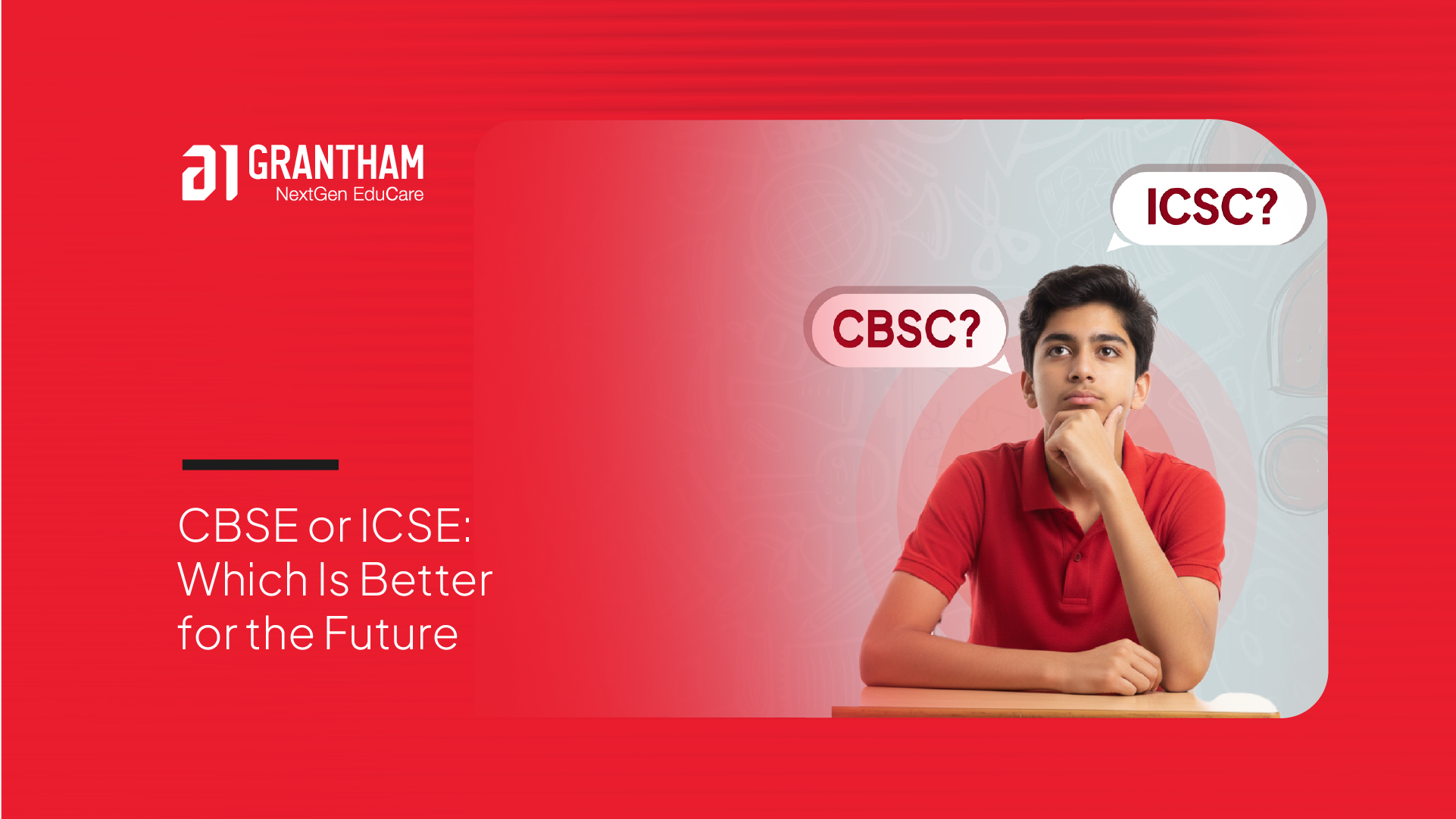
Choosing the right education board is one of the most important academic decisions parents make for their children. With the growing competitiveness in higher education and global opportunities, the debate between the CBSE curriculum and the ICSE curriculum has become more relevant than ever. While both boards offer strong academic foundations, their philosophies, teaching styles, and long-term advantages differ greatly.
At Grantham NextGen Educare, we understand how overwhelming this choice can be. Our goal is to help parents make informed, future-ready decisions that align with a child’s aspirations, interests, and learning style. This comprehensive blog explores the structures, strengths, differences, and future implications of both boards—so you can choose what truly serves your child’s long-term success.
Overview of CBSE and ICSE
What is CBSE?
CBSE, or the Central Board of Secondary Education, is India’s national education board regulated by the Ministry of Education. It follows the National Curriculum Framework (NCF) and is designed to:
- Provide standardized education across India
- Align closely with national competitive exams (JEE, NEET, NDA, etc.)
- Offer a structured, concept-focused, and easily accessible curriculum
It emphasizes core subjects, scientific aptitude, and application-based learning, making it highly suitable for students aiming for competitive exams within India.
What is ICSE?
ICSE refers to the Indian Certificate of Secondary Education, governed by the Council for the Indian School Certificate Examinations (CISCE). ICSE is known for:
- Its comprehensive, detail-oriented, and balanced curriculum
- An equal focus on sciences, humanities, and languages
- Strong emphasis on English language proficiency
The board is rigorous and holistic, helping students build analytical, creative, and linguistic skills valuable for global education systems.
Key Differences and Future Impact
Future Goal (India vs. Abroad)
The choice between CBSE and ICSE often comes down to a child’s future academic destination.
For Indian Competitive Exams
CBSE is generally preferred because:
- Its syllabus aligns closely with competitive exams like IIT-JEE, NEET, CUET, etc.
- The curriculum focuses heavily on Maths and Science fundamentals.
- Exam patterns mirror national entrance testing styles.
For International Studies
ICSE is often considered advantageous because:
- It promotes strong English proficiency, a key requirement abroad.
- The curriculum resembles international boards like IGCSE and IB.
- Many foreign institutions consider ICSE scores more familiar in structure.
Verdict:
- Choose CBSE for India-centric academic goals.
- Choose ICSE for global academic ambitions.
Curriculum Structure
CBSE provides a structured and compressed curriculum, while ICSE promotes a comprehensive and expansive one.
- CBSE is concept-focused and exam-oriented.
- ICSE is content-rich, with detailed chapters and extensive subject material.
If your child thrives on depth and detail, ICSE may be better. If simplicity and clarity suit them, CBSE may be the ideal option.
Skill Development
Each board develops different sets of skills in students:
CBSE encourages
- Problem-solving
- Logical reasoning
- Analytical thinking
- Exam performance skills
ICSE encourages
- Creativity
- Language mastery
- Research-oriented learning
- Practical and project-based skills
Both skill sets are valuable—choosing one depends on the learner’s profile and long-term aspirations.
Accessibility
CBSE is widely available in India, making it the more convenient option for families who may relocate frequently.
- Wider presence across cities and towns
- More affordable school options
- Easier availability of books, tutors, and coaching centers
ICSE is prominent mainly in metro cities and internationally inclined schools.
Curriculum Structure Comparison
CBSE Curriculum
The CBSE curriculum is designed to be:
- Student-friendly
- Less burdened with textbooks
- Highly logical and structured
It particularly excels in:
STEM Readiness
CBSE lays a solid foundation for Mathematics and Science, making it compatible with the frameworks of JEE and NEET.
Value Education + Skill Subjects
Recent additions like coding, AI, and skill-based modules make the curriculum future-ready.
Reduced Stress Approach
The syllabus avoids unnecessary detail, helping learners grasp concepts faster without cognitive overload.
ICSE Curriculum
The ICSE curriculum is:
- Detailed, comprehensive, and academically rich
- Balanced between Sciences, Arts, and Languages
- Known for its practical assignments and internal assessments
It excels in:
Language and Communication
Students develop strong expressive and comprehension skills in English—useful for global opportunities.
Interdisciplinary Learning
ICSE integrates arts, humanities, and technical subjects seamlessly, ensuring a holistic approach.
Critical Thinking and Creativity
Project-based learning forms a significant part of ICSE assessments, encouraging creativity and innovative thinking.
Which One to Choose?
Every child is unique, so the “best” board depends on their goals, personality, learning style, and family priorities. Grantham NextGen Educare recommends evaluating the board based on your child’s long-term academic pathway.
Choose CBSE if:
- Your child aims to appear for national competitive exams.
- You want a straightforward, exam-oriented, and concept-focused approach.
- Your family may relocate frequently and need easily accessible schools across India.
- You prefer a curriculum aligned with NCERT, which is widely accepted.
- You want lower academic pressure and simplified content.
CBSE is ideal for students who thrive in a structured environment with clear learning outcomes.
Choose ICSE if:
- You want a curriculum that focuses deeply on English language mastery.
- Your child is inclined towards arts, humanities, or literature.
- You are considering sending your child abroad for higher education.
- You prefer project-oriented, practical, and comprehensive learning.
- Your child enjoys reading, writing, and creative expression.
ICSE is suitable for students who are curious, expressive, and enjoy exploring subjects deeply.
Conclusion
Choosing between CBSE and ICSE isn’t about deciding which board is universally superior—it’s about identifying the board that aligns with your child’s aspirations, learning style, and future goals.
With its structured approach, exam-oriented curriculum, and nationwide presence, CBSE is perfect for students aiming for Indian competitive exams and systematic learning. On the other hand, ICSE offers a rich, detailed, and globally compatible curriculum ideal for enhancing communication skills, creativity, and international prospects.
At Grantham NextGen Educare, we guide parents at every step—helping them understand each board, evaluate their child’s strengths, and choose a curriculum that builds a strong academic foundation while nurturing lifelong skills.
The right choice today becomes the stepping stone toward your child’s successful tomorrow.
FAQs
1. Which board is better for competitive exams, CBSE or ICSE?
CBSE is generally better for competitive exams like JEE, NEET, and CUET, as its syllabus is closely aligned with exam patterns and NCERT content.
2. Is ICSE more difficult than CBSE?
ICSE is often considered tougher due to its depth, detailed chapters, and comprehensive subject coverage. CBSE is more streamlined and student-friendly.
3. Should parents choose CBSE or ICSE based on reputation?
Reputation alone shouldn’t be the deciding factor. Instead, consider your child’s strengths, learning needs, and long-term goals.
4. Which is best for the future, CBSE or ICSE?
Both are excellent.
- CBSE is ideal for engineering/medical aspirants in India.
- ICSE is advantageous for international studies and language-heavy fields.
5. Is ICSE good for IIT?
Yes, ICSE gives strong foundational knowledge. However, CBSE has a slight advantage since IIT-JEE is aligned with the NCERT syllabus.