

CBSE Class 10 Sample Papers: How to Practise With Them, Not Just Download Them


Downloading sample papers is easy. Using them effectively is what makes a difference to exam preparation. Many Class 10 students collect several question papers, save them on their phones or laptops, and assume they are preparing well. However, unless those papers are attempted, analysed and used to improve weak areas, their academic value remains limited.
CBSE sample papers class 10 are designed to familiarise students with the examination pattern, question formats, marking scheme and level of difficulty. They also provide an opportunity to test subject knowledge under realistic conditions. When used strategically, sample papers can help students identify gaps in understanding, improve time management and develop confidence before the final examination.

Why CBSE Class 10 Sample Papers Matter
The Class 10 board examination requires more than memorising textbook information. Students must understand concepts, interpret questions, organise answers and manage time within a fixed examination period. Sample papers help students become familiar with these demands.
01Exam Structure
Familiarity with question formats and paper layout.
02Applied Practice
Applying concepts rather than simply recalling them.
03Marks Distribution
Understanding how marks are allocated across questions.
04Gap Identification
Spotting frequently misunderstood topics.
05Speed & Accuracy
Improvement in presentation and precision.
06Confidence
Greater comfort with unfamiliar, application-based questions.
Sample papers should not be treated as predictions of the actual examination. Their purpose is to develop preparedness across the syllabus, not to encourage students to study only selected questions.
Step 1: Understand the CBSE Class 10 Syllabus Before Practising
Before attempting a sample paper, students should review the CBSE Class 10 syllabus for the relevant academic session. The syllabus establishes which chapters, concepts and skills are included in the examination, and helps students understand the expected scope of preparation. Without this step, students may attempt questions from topics that are not relevant to their current examination or overlook important areas that require revision.
| Category | What It Means |
|---|---|
| Strong | Concepts are understood and questions can be solved independently |
| Improving | Concepts are familiar, but mistakes or confusion remain |
| Weak | Topics need revision and additional practice |
This classification helps students identify where sample papers can be most useful. It is also important to check the latest official CBSE syllabus and sample paper rather than relying entirely on older resources, since examination patterns and syllabus details may change between academic sessions.
Step 2: Start With Chapter-Wise Practice
Students who have recently completed the syllabus should not immediately attempt full-length papers every day. Chapter-wise practice is often more productive during the initial stage because it allows students to focus on specific concepts without the pressure of completing an entire examination. For example, after revising quadratic equations in CBSE Class 10 Maths, students can solve relevant questions from sample papers and previous examinations. Similarly, after studying chemical reactions in CBSE Class 10 Science, they can practise questions involving equations, observations, applications and conceptual explanations.
01Identify Gaps Early
Spot concepts that need further revision right away.
02Learn Question Framing
Understand how examiners phrase questions on a topic.
03Build Accuracy
Improve precision before attempting mixed questions.
04Build Confidence
Gain confidence gradually, chapter by chapter.
Once most chapters have been revised, students can transition to full-length papers.
Step 3: Attempt Papers Under Real Examination Conditions
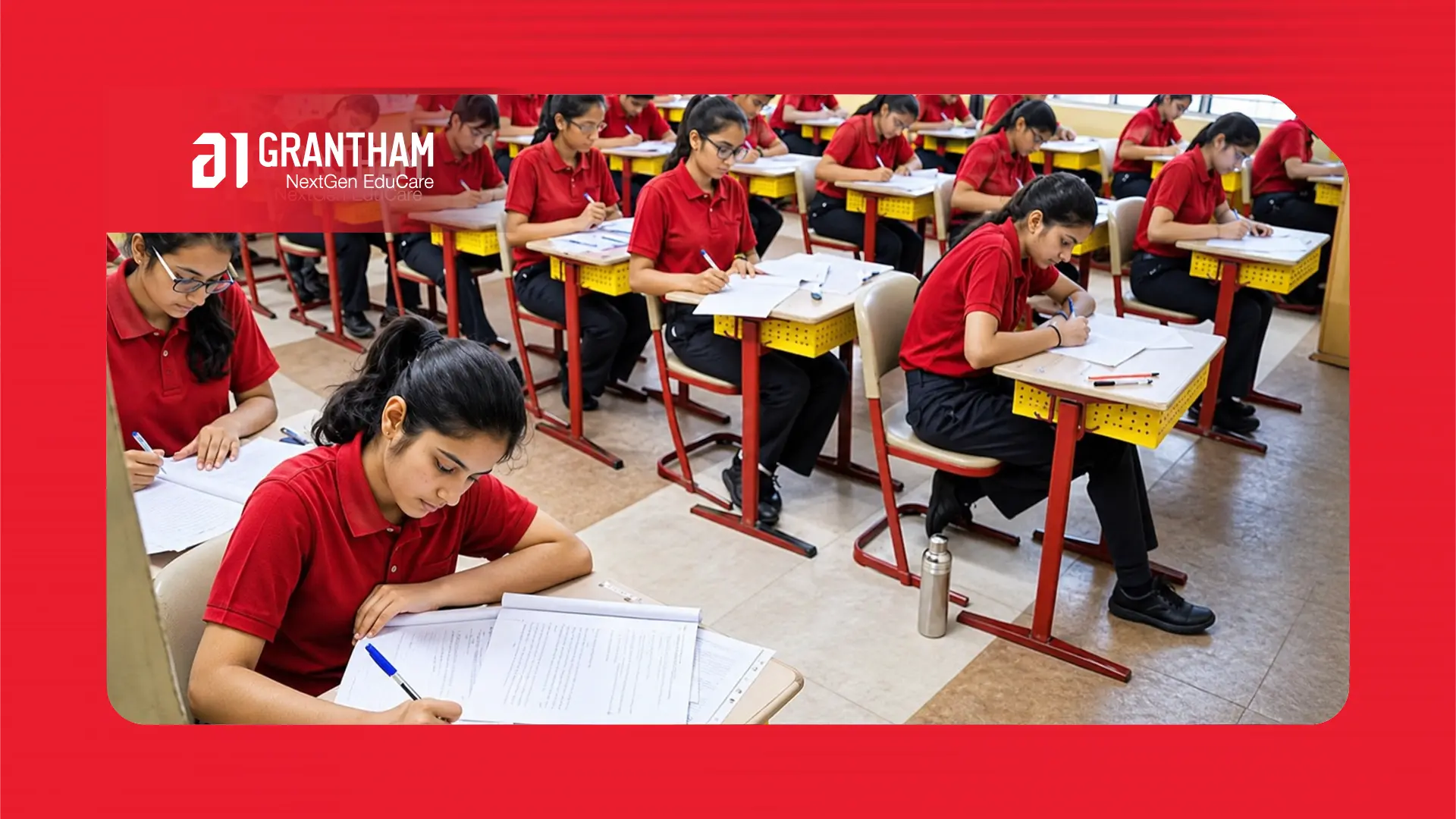
One of the most valuable ways to practise CBSE sample papers class 10 is to recreate the examination environment. Students should choose a quiet space, keep their stationery ready and attempt the paper within the prescribed time.
01No Notes
Avoid textbooks, notes or solution guides during the attempt.
02No Distractions
Keep mobile phones and other distractions away.
03Full Duration
Follow the actual prescribed examination duration.
04Planned Order
Attempt questions in a planned, deliberate order.
05Review Time
Leave sufficient time at the end for checking answers.
This approach reveals how well students can apply their knowledge independently, and helps identify practical challenges such as spending too much time on difficult questions or rushing through the final section. A paper completed with frequent pauses and textbook assistance may be useful for learning, but it should not be considered a realistic assessment of examination readiness. Regular low-stakes practice testing also carries a separate benefit beyond readiness: a meta-analytic review of practice tests and quizzes found that practice tests appreciably reduced test anxiety on average, with easier practice tests tending to be more effective at easing anxiety than very difficult ones — a reason to attempt a realistic mix of difficulty levels rather than only the hardest questions.
Step 4: Practise Each Subject Differently
Every subject requires a different preparation strategy. Using the same approach for Mathematics, Science, English and Social Science may limit improvement.
CBSE Class 10 Maths
Mathematics requires conceptual clarity, regular practice and accurate calculations. Students should focus on writing complete steps, practising questions from different chapters, revising formulas and identities, checking calculations and signs, understanding alternative methods, and managing time across easy and difficult questions. Students should avoid memorising solutions without understanding the underlying method — a question may appear familiar but include a small variation that requires independent reasoning. After attempting a paper, identify whether mistakes occurred because of weak concepts, calculation errors or incorrect interpretation.
CBSE Class 10 Science
Science combines theoretical understanding, numerical problem-solving and application-based questions. Practice should include conceptual explanations, numericals and formula-based questions, chemical equations and reactions, diagrams and labelling, case-based questions, and reasoning and assertion-style questions where included. Students should pay attention to the wording of questions — terms such as explain, compare, justify and calculate require different kinds of responses. A correct concept presented without the required explanation may not earn full marks.
English and Social Science
English requires attention to comprehension, writing formats, grammar and literature-based answers — students should practise writing within word limits and responding directly to the question. Social Science requires factual knowledge as well as organised explanations: writing answers with relevant points, using headings when appropriate, supporting explanations with examples, revising dates, terms and definitions, and reading maps where required. For both subjects, presentation and relevance are important — lengthy answers do not automatically receive better marks.
Step 5: Analyse Mistakes Instead of Only Checking Marks
Checking the score after completing a sample paper is not enough. The real value of practice comes from understanding why marks were lost. Students should review each incorrect, incomplete or uncertain answer carefully.
| Mistake Type | What It Indicates |
|---|---|
| Conceptual error | The topic needs revision |
| Calculation error | Accuracy or checking needs improvement |
| Misreading | The question was not interpreted correctly |
| Incomplete answer | Important points were missing |
| Time-management issue | The question took too long |
| Presentation issue | The answer lacked clarity or structure |
This analysis turns a sample paper into a personalised revision tool. For example, if a student repeatedly loses marks in application-based Science questions, simply attempting more papers may not solve the problem — the student should revisit the relevant concepts and practise similar questions separately. Structured mistake classification is an established approach in education research as well: a recent comparison of error-classification frameworks in mathematics education found that systematically classifying the type of error behind a wrong answer — rather than only recording that it was wrong — made it easier to identify precise causes and target improvement strategies. Maintain a mistake notebook containing the question, the error, the correct approach and a short explanation of what to remember next time.
Step 6: Use Solutions and Marking Schemes Properly
Solutions should support learning, not replace independent effort. After attempting a paper, compare answers with the official marking scheme or a reliable solution guide. Pay attention to the expected steps, keywords, explanations and marks distribution.
01Answered Directly?
Did the response address the question asked?
02All Steps Included?
Were all required steps shown?
03Concept Supported?
Was the explanation backed by relevant concepts?
04Right Terminology?
Was the correct subject terminology used?
NCERT Solutions Class 10 can be useful when revising textbook exercises and strengthening foundational concepts. However, students should not depend exclusively on memorised textbook answers — sample papers often require concepts to be applied in unfamiliar contexts, and understanding the principle behind an answer is more valuable than remembering its exact wording.
Step 7: Combine Sample Papers With Previous Year Question Papers
Sample papers and class 10 previous year question papers serve different but complementary purposes. Sample papers help students practise the current examination structure and question formats. Previous year papers provide insight into how concepts have been tested in actual examinations. A balanced preparation plan should include both.
01Understand Style
How board examination questions are typically worded.
02Observe Patterns
How concepts have been tested across different years.
03Practise in Context
Important topics within an examination-style setting.
04Spot Weak Areas
Topics that require consistent revision.
However, students should not assume that questions will be repeated exactly. Previous papers are valuable for understanding patterns and developing familiarity, not for predicting the next examination — always prioritise the latest official sample paper and syllabus when preparing for the upcoming session. Explore Grantham Educare’s board coaching courses for Classes 8 to 12 for how this balance is built into structured preparation.
Step 8: Create a Practical Sample Paper Schedule
Attempting too many papers without reviewing them can become counterproductive. A manageable schedule should include revision, practice and analysis.
| Preparation Stage | Recommended Practice |
|---|---|
| Early preparation | Chapter-wise questions after revision |
| Syllabus completion | One subject-wise paper at a time |
| Revision phase | Full-length papers under timed conditions |
| Final preparation | Selected papers, mistake review and targeted revision |
Students should adjust the schedule according to their preparation level and available time. After every full-length paper, reserve time to review mistakes and revise weak topics — this step is just as important as attempting the paper itself. Grantham Educare’s approach to building a strong academic foundation for students follows a similar staged structure.
Common Mistakes Students Should Avoid
Even motivated students may use sample papers inefficiently.
01Hoarding, Not Attempting
Downloading numerous papers but attempting very few.
02No Time Limit
Solving papers without following the time limit.
03Checking Mid-Paper
Looking at answers before completing the attempt.
04Ignoring Errors
Reviewing marks but not the mistakes behind them.
05Memorising Answers
Instead of understanding the underlying concept.
06Avoiding Hard Questions
Practising only familiar or easy ones.
A smaller number of carefully analysed papers can be more useful than a large collection completed without reflection.
Conclusion
CBSE sample papers class 10 are most effective when students treat them as a structured learning tool rather than a collection of downloadable documents. Their purpose is to strengthen conceptual understanding, improve examination skills and reveal areas that require further attention.
The process should begin with syllabus awareness, continue through chapter-wise and full-length practice, and include detailed analysis of mistakes. Combining sample papers with NCERT Solutions Class 10 and class 10 previous year question papers creates a more balanced preparation strategy. Ultimately, progress depends not on how many papers a student completes, but on how much they learn from each attempt. Consistent practice, thoughtful revision and honest evaluation can make preparation more focused and effective.
Want Help Turning Sample Papers Into Real Progress?
Talk to Grantham Educare’s mentors about a structured, syllabus-aligned practice plan.
Book a Free Consultation →FAQs
1. How many CBSE Class 10 sample papers should I solve?
There is no fixed number. Students should attempt enough papers to become comfortable with the examination pattern while leaving sufficient time for revision and mistake analysis.
2. When should I start solving sample papers?
Begin chapter-wise practice after completing individual topics. Full-length papers are most useful once a substantial portion of the syllabus has been revised.
3. Are sample papers more important than previous year question papers?
Neither should replace the other. Sample papers help with current examination preparation, while previous year papers provide familiarity with actual board questions.
4. Should I solve sample papers before completing the syllabus?
You can use chapter-wise questions before completing the syllabus. However, full-length papers are more useful when you have revised most of the prescribed content.
5. Where should I find reliable CBSE Class 10 sample papers?
The official CBSE academic website is the preferred source for current sample papers and marking schemes. Students should verify that the resources match their examination session.
